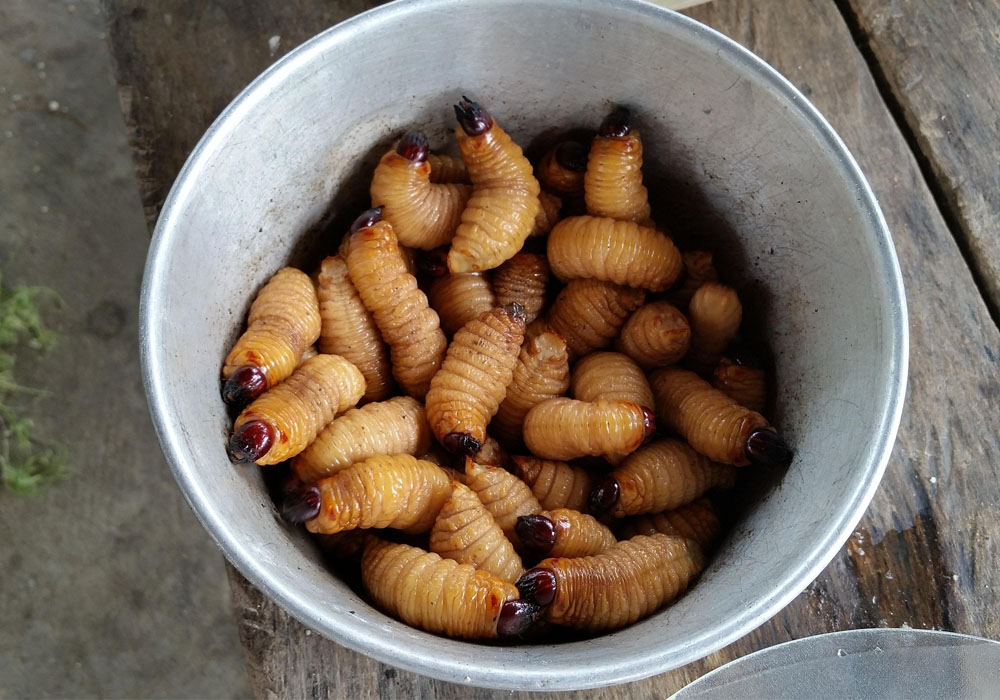
The journey of the sago worm food begins with the Red Palm Weevil (Rhynchophorus ferrugineus). When a sago tree is felled and its starch harvested, the remaining trunk is left to return to the earth.
If you travel deep enough into the rainforests of Papua, the Mentawai Islands, or the marshlands of Southeast Sulawesi, you will eventually find yourself in a sago grove.
Here, the air is thick with the scent of damp earth and decaying wood. To an outsider, a fallen sago trunk might look like waste, but to us, it is a treasure chest. Inside these soft, fibrous logs lives one of Indonesia’s most misunderstood delicacies: the Ulat Sagu, or sago worm.
In Papua and Maluku, where rice was once a stranger, sago has always been the “Pohon Kehidupan”—the Tree of Life. But while the white starch provides our energy, it is the sago worm that provides our strength.
This is not “bizarre food” meant for a dare; it is a vital source of protein, fat, and local wisdom that has sustained our ancestors for thousands of years.
The Lifecycle of the Sago Worm Food
The journey of the sago worm food begins with the Red Palm Weevil (Rhynchophorus ferrugineus). When a sago tree is felled and its starch harvested, the remaining trunk is left to return to the earth.
The weevil senses this and lays its eggs in the soft, fermenting core. Over the next several weeks, the larvae grow into plump, cream-colored grubs, feeding exclusively on the nutrient-rich sago pith.
When we go into the forest to harvest them, it is a moment of gratitude. You listen for the faint scratching sound inside the wood—the sound of the forest working. Cracking open a trunk to find hundreds of fat, healthy worms is seen as a blessing from the spirits of the land.
In many Papuan tribes, like the Asmat, this is so significant that it is celebrated with the Sago Caterpillar Festival Dance, a rhythmic, powerful ceremony where the community gives thanks for the abundance of the forest.
A Texture Like No Other
There is a common misconception that sago worms are “slimy.” As someone who has shared this meal in many villages, I can tell you the reality is quite different.
When eaten raw, as is traditional in many parts of Papua and the MentawaiIslands of West Sumatra, the experience is surprising. The head is crunchy, and as you bite, the body bursts with a liquid that is rich, milky, and slightly sweet.
It tastes like a combination of coconut milk and fresh forest air. For the Mentawai people, eating them raw is a way to consume the “living energy” of the forest.
However, if you are not ready for the raw experience, there is nothing like a Sate Ulat Sagu. When grilled over an open fire or deep-fried, the skin turns golden and crispy, while the inside melts into something resembling a savory butter or a very rich, smoky egg yolk.
In Southeast Sulawesi, these are often incorporated into daily snacks for children because our mothers know they are packed with the iron and amino acids needed to grow strong.
The Wisdom of Sustainability
What is most beautiful about the sago worm is the local wisdom of “zero waste.” In the modern world, we talk about the “circular economy,” but our people have been practicing it for centuries. We take the starch for our Papeda (sago porridge), use the leaves for our roofs, and then use the “waste” of the trunk to farm the worms. Nothing is taken from the forest without a purpose, and nothing is thrown away.
To eat a sago worm is to participate in this ancient cycle. It is an invitation to look past appearances and understand that nature provides everything we need if we know how to listen to the scratching in the wood.
Travelers’ Guide: How to Experience Ulat Sagu
If you are visiting Papua, especially around Lake Sentani, look for the Yoboi Village. They host a Sago Worm Festival where you can see the entire process—from the felling of the tree to the traditional ways of cooking. It is a place where you aren’t just a tourist; you are a guest at nature’s table.
To help you get to these remote corners of Indonesia, I’ve put together a few resources for your adventure:
- [Book Your Guided Cultural Tours in Papua with GetYourGuide platform] – Connect with local guides who can safely introduce you to tribal traditions.
- [Use VisitorsCoverage for you Best Travel Insurance for Remote Indonesia] – Essential for when your storytelling takes you off the beaten path.
By choosing these services,with NO extra cost to you, you help Gindoo.com continue to document and preserve the diverse, beautiful, and sometimes “wild” flavors of our archipelago