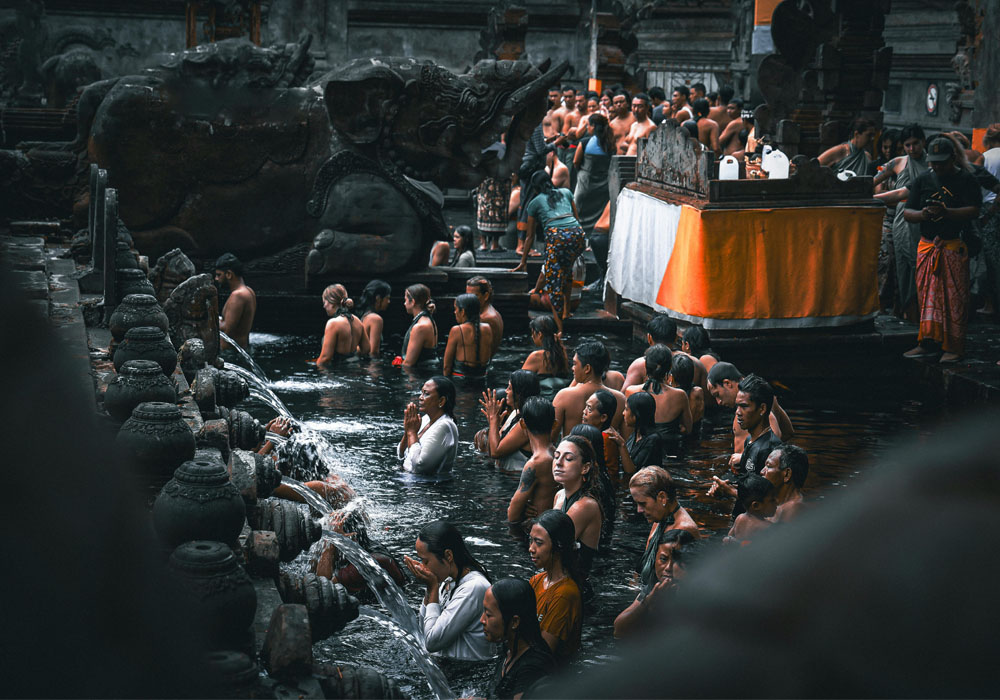
I am visiting the Tirta Empul temple in the early morning, just as the mist begins to lift from the lush valleys of Tampaksiring. The air is cool and thick with the scent of damp earth and blooming frangipani. While the rest of Ubud is slowly stirring to life, here at Tirta Empul, the world feels as though it has been awake for centuries, breathing in rhythm with the steady pulse of water.
As I step through the Candi Bentar (the split gateway), the sound hits me first — not a roar, but a rhythmic, melodic splashing. It is the sound of thirty stone waterspouts pouring crystal – clear mountain water into rectangular pools. The light of the rising sun catches the ripples, turning the water into liquid silver.
The Legend of Immortal Healing
To understand Tirta Empul, one must look back into the tapestry of Balinese mythology. Local lore tells the story of a cosmic battle between the forces of good and evil. It is said that the temple was created by the God Indra.
During a fierce war against the defiant and powerful King Mayadenawa, the king poisoned the nearby rivers, causing Indra’s army to fall ill. In a moment of divine intervention, Indra pierced the earth with his staff, and from that hole sprouted the Amerta—the nectar of immortality. These holy springs healed his troops and allowed them to defeat the dark king. Since 962 AD, during the Warmadewa dynasty, this site has stood as a testament to that victory of light over darkness, and the water has never ceased to flow.
The Ritual of Melukat: Cleansing the Soul
I watch as a local family enters the pool. They are dressed in traditional sarongs, their hands pressed together in prayer. This is the heart of Tirta Empul: the Melukat ritual. It is a spiritual purification process that goes far beyond simple bathing.
In Balinese culture, we believe that we carry “heavy” energy — stresses, sins, and negative emotions — that cloud our spirit. To stand under the waterspouts is to ask the universe for a reset. I watch a young woman move from the first spout to the last. At each one, she bows her head, allows the water to drench her hair and shoulders, and sips the water three times before washing her face.
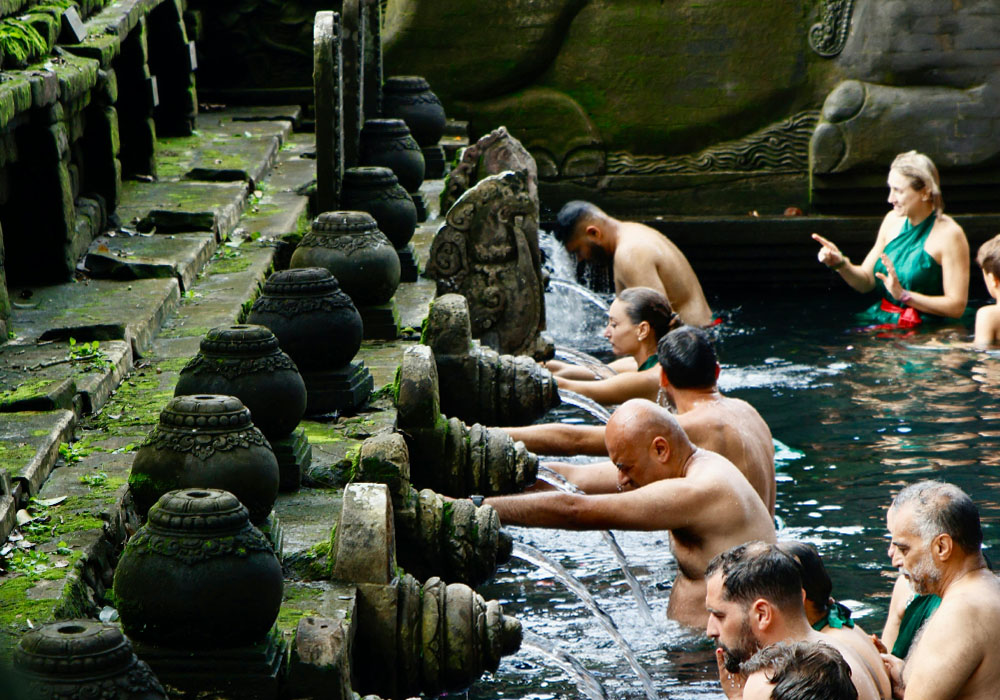
There is a profound silence in her movement. Each spout has a specific purpose: some are for cleansing the soul, some for healing physical ailments, and some for warding off evil spirits. However, there are two spouts at the end reserved only for funerary rites; the locals respect these boundaries with a quiet, innate knowledge that prevents them from crossing into the sacred space of the departed.
Tri Hita Karana: The Wisdom of Connection
Sitting on the moss-covered stones, I am reminded of the local wisdom that governs life in Bali: Tri Hita Karana. This philosophy dictates that happiness is only achieved through three harmonies: harmony with God (Parhyangan), harmony with fellow humans (Pawongan), and harmony with nature (Palemahan).
Tirta Empul is the physical manifestation of this wisdom. You see it in the way the temple architecture hugs the natural spring, in the way the community comes together to maintain the shrines, and in the deep reverence shown to the water itself. To the Balinese, water is not just a resource; it is Tirta, a living deity that bridges the gap between the physical and the divine.
The Inner Sanctum and the Koi Pond
Moving past the bathing pools, I enter the inner courtyard, or Jeroan. Here, the atmosphere shifts from the active energy of the water to a profound, meditative stillness. This is the oldest part of the complex, where the actual spring bubbles up from the ground.
The water here is so clear it looks like glass. You can see the fine black sand dancing at the bottom as the spring pushes upward. Large, colorful Koi fish glide effortlessly through the reeds, looking like ancient guardians of the source. Old men sit on the brick pavilions, chanting softly, their voices mingling with the distant sound of a gamelan rehearsal. It is a place where time feels irrelevant.
Planning Your Journey to the Springs
If you are planning to visit this sacred site for your own journey of reflection, here are the practical details to guide your way:
- How to Get There: Tirta Empul is located in the village of Manukaya, Tampaksiring. From the center of Ubud, it is about a 30-to-40-minute drive northward. You can easily reach it by renting a scooter for about IDR 75,000 per day or hiring a private driver for a half-day tour (approx. IDR 500,000).
- Entrance Fees: As of recent updates, the entrance fee for international tourists is approximately IDR 50,000 for adults and IDR 25,000 for children. If you wish to participate in the Melukat (ritual bathing), there is an additional small fee (around IDR 25,000) for the rental of a special green ritual sarong and a locker.
- The Best Time to Visit: I cannot stress this enough—arrive early. Aim to be at the gates by 8:00 AM. By 10:30 AM, tour buses arrive, and the serene atmosphere can become crowded. For an even more spiritual experience, visit during a Full Moon (Purnama), though be prepared to share the space with hundreds of locals who come to pray.
A Final Reflection
As I walk back toward the exit, passing through the labyrinth of local market stalls selling wood carvings and colorful fabrics, I feel lighter. Whether you believe in the legends of Indra or simply appreciate the beauty of ancient architecture, there is an undeniable energy at Tirta Empul.
It teaches us that no matter how much “poison” we encounter in our daily lives — be it stress, anger, or fatigue — there is always a spring of renewal waiting for us, provided we are willing to step into the water and let the past flow away.