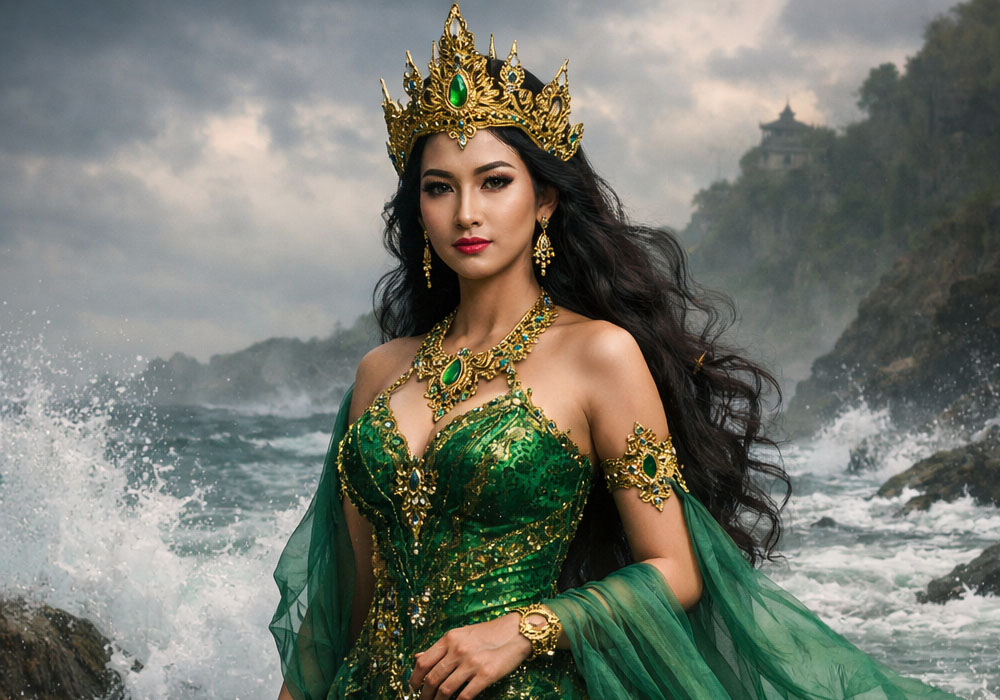
Nyi Roro Kidul is the personification of the ocean: beautiful, life-giving, but capable of immense destruction if disrespected. She is the reminder that Indonesia is a land where the modern world and the ancient spirit realm still walk hand-in-hand.
I am visiting the jagged, volcanic shoreline of Parangtritis in the early morning, long before the sun has scorched the sand. The wind here doesn’t just blow; it howls, carrying the salt of the Indian Ocean and a weight that feels almost physical. To my left, the cliffs of Yogyakarta rise like fortress walls; to my right, the waves arrive with a thunderous violence that locals know to respect.
In Java, we do not just see the ocean; we acknowledge its Sovereign. This is the domain of Nyi Roro Kidul, the Green Queen, the Goddess of the Southern Sea.
The Legend of the Cursed Princess
The story of the Queen is etched into the soul of Javanese history. Long ago, she was known as Dewi Kadita, a stunning princess of the Pajajaran Kingdom. Blessed with a beauty that outshone the sun, she became the target of a palace conspiracy. Her stepmother, consumed by jealousy, hired a powerful sorcerer to cast a black magic spell upon her.
Overnight, the princess’s porcelain skin turned into a mass of rotting sores. Driven by shame and despair, she fled the palace, wandering until she reached the cliffs of the South Coast. Hearing a voice from the depths of the ocean, she threw herself into the crashing waves.
The sea did not take her life; it transformed her. The water washed away the curse, restoring her beauty and granting her eternal life. She rose as the Queen of the Spirit World, ruling over an underwater empire of mermaids, spirits, and ancient guardians.
The Sacred Bond: The Sultan and the Queen
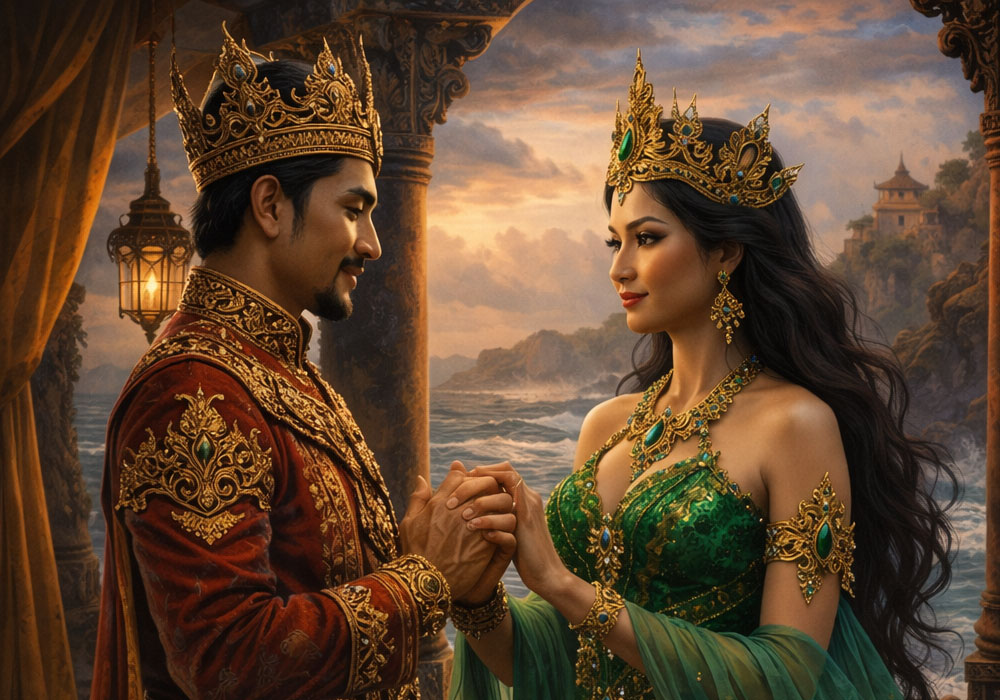
What makes Nyi Roro Kidul more than just a fairy tale is her deep connection to the Sultanate of Yogyakarta. Since the 16th century, it has been believed that the founding father of the Mataram Kingdom, Senopati, entered into a spiritual marriage with the Queen.
This wasn’t just a romance; it was a political and spiritual alliance. In exchange for his devotion, she promised to protect his lineage and his kingdom from the unseen world. To this day, the Sultans of Yogyakarta perform the Labuhan ceremony, where offerings of hair, fingernails, and royal clothes are cast into the sea at Parangkusumo to honor this ancient pact. It is a reminder that even the most powerful kings must acknowledge the forces of nature and the spirit.
Local Wisdom: The Taboo of Green
Standing on the beach, you will notice something peculiar. Among the thousands of visitors, you will rarely see anyone wearing green.
Local wisdom dictates that green is the Queen’s favorite color—it is her royal uniform. There is a chilling belief that if you wear green into her waters, she will “claim” you for her underwater army. While skeptics call it a myth, the locals treat it with a quiet, unwavering seriousness.
This taboo teaches us a fundamental Balinese and Javanese value: Respect for the Host. When you enter a space that is not yours—whether it is a forest, a mountain, or a sea—you must follow the house rules. It is an exercise in humility, a realization that humans are merely guests in a much larger, older world.
Seeking the Queen: Practical Information
If your journey takes you to the southern shores of Java to pay your respects, here is what you need to know:
- Where to Go: The most famous spots to “feel” her presence are Parangtritis Beach (near Yogyakarta) and Pelabuhan Ratu (West Java).
- In Pelabuhan Ratu, the Samudra Beach Hotel maintains Room 308, which is kept permanently empty, decorated in green and gold, and filled with offerings specifically for the Queen.
- The Ritual of Labuhan: If you want to witness the offerings being made, check the Javanese calendar for the Sultan’s coronation anniversary (Tingalan Dalem Jumenengan).
- Entry Fees: Entrance to Parangtritis Beach is approximately IDR 15,000. To visit the “Queen’s Room” (Room 308) in Pelabuhan Ratu, a small donation or a viewing fee of around IDR 25,000 is common.
- Best Time to Visit: The golden hour—just before sunset—is when the atmosphere is most electric. The shadows lengthen, and the veil between our world and hers feels thinnest.