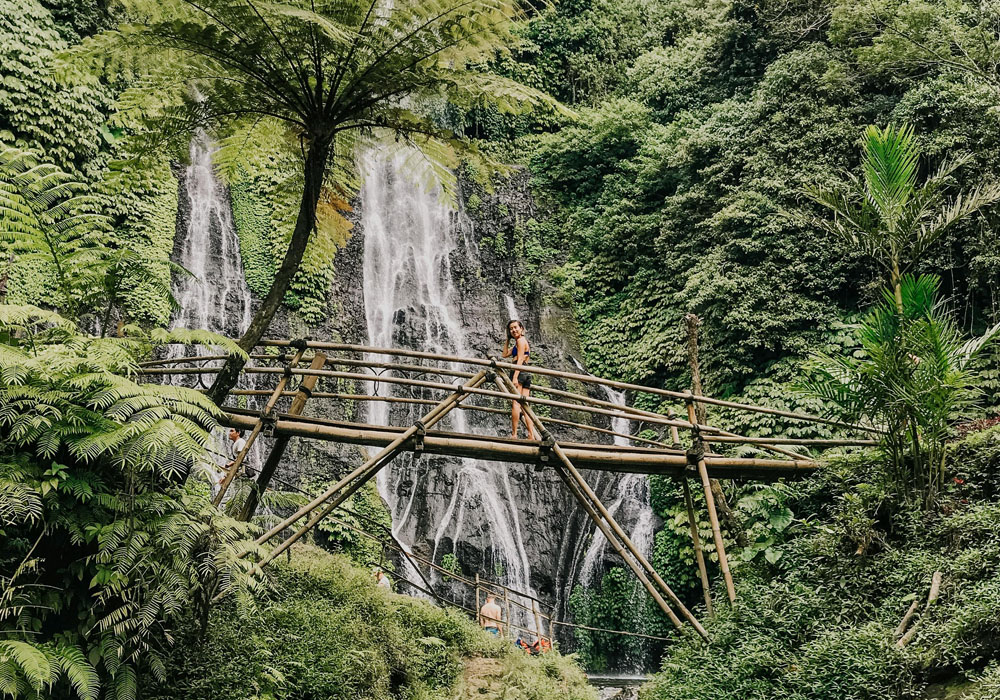
Banyumala Twin Waterfall isn’t just a sight for your camera; it is a Pura Alam — a temple of nature. In the heart of North Bali, where the air turns crisp and the mist clings to the clove trees, lies a place that feels less like a tourist destination and more like a whispered secret from the ancestors.
To talk about Banyumala is to understand that for us Balinese, water is not just H_2O. It is Amrta, the nectar of life. When you visit Banyumala, you aren’t just going for a swim; you are entering a space governed by the philosophy of Tri Hita Karana: the harmony between humans, nature, and the Divine.
The Journey: More Than Just a Trek
To reach Banyumala, you must travel to the village of Wanagiri. The road winds through the highlands of Bedugul, past the “twin lakes” of Buyan and Tamblingan. Locals believe these lakes are the lungs of Bali.
The descent to the waterfall is a lesson in patience. You walk down narrow, winding paths carved into the earth. You’ll pass coffee shrubs and hydrangea bushes blooming in vibrant blues and purples. You might see a local farmer carrying a basket of cloves or ginger. They will likely greet you with a smile and a “Rahajeng,” because here, the pace of life is dictated by the sun and the soil, not the clock.
EXPLORE WATERFALLS IN MUNDUK
The Sacred Banyumala Twin Waterfall: A Natural Melukat
When you finally reach the base, the sight is breathtaking. But don’t just rush in. Look at how the water flows. Banyumala is unique because it isn’t one violent drop; it is a curtain of several smaller falls that converge into a central pool.
This is a place for Melukat (spiritual cleansing). We believe that running water from a natural spring carries the power to wash away Mala — the spiritual impurities or “heavy energy” we gather from daily stress, anger, or grief.
- The Symbolism: The “Twin” aspect represents the balance of Rwa Bhineda — the Balinese concept of opposites (light/dark, joy/sorrow, male/female). The waterfalls exist in harmony, reminding us that life requires balance to be beautiful.
- The Sound: We call the sound of the falls Suara Alam. It is believed to be a natural mantra that clears the mind of “noise.”
Respecting the “Tenget” (Sacredness)
I have to tell you about the concept of Tenget. Some places in Bali are considered “power spots” where the veil between our world and the spirit world is thin. Banyumala is one of them.
Local wisdom dictates a few “unspoken rules” that go beyond the signs posted at the entrance:
| Practice | Local Meaning |
| Keep it Quiet | Loud shouting disturbs the Gamang (nature spirits) and breaks the peace of the valley. |
| Dress Modestly | Even if you are swimming, we cover up until we reach the water out of respect for the land. |
| No Littering | We believe the land is borrowed from our grandchildren. To dirty it is a sin against the future. |
| Permisi (Asking Permission) | Before entering the water, many locals will pause, offer a silent prayer, or flick a bit of water onto their head as a sign of respect to the Dewi Danu (Goddess of the Waters). |
The Village Connection: Wanagiri’s Spirit
The people of Wanagiri are the guardians of this waterfall. For generations, they have lived off the land. When you pay your entrance fee or buy a coffee at a local stall, you aren’t just paying for a service; you are contributing to the Banjar (community) that maintains the trails and protects the forest from over-development.
There is a deep sense of Gotong Royong (mutual cooperation) here. If a path is washed away by the monsoon rains, the villagers don’t wait for a government permit; they pick up their tools and fix it together. They see Banyumala as a gift from the ancestors that must be kept “as is”—wild, green, and pure.
Why It Matters Today
In a world that is moving faster and faster, Banyumala stands still. It reminds us of the Balinese proverb: “Agama Tirta” — the Religion of Water. Water connects the mountains to the sea, the past to the present.
When you stand under the cool spray of Banyumala, the water isn’t just hitting your skin; it’s grounding you. The local way of experiencing this place isn’t about the “perfect shot” for social media. It’s about sitting on a mossy rock, feeling the temperature of the air drop, and realizing that we are just a small part of a much larger, living breathing ecosystem.
A Note for the Soulful Traveler
If you decide to visit, try to go early in the morning, just as the sun begins to pierce through the canopy. The light creates small rainbows in the mist—what the elders sometimes call the “bridge of the gods.”
Listen to the birds, smell the damp earth, and for a moment, put the phone away. Let the water of Banyumala do what it has done for centuries: wash away the unnecessary and leave you with what is real.