Bali is a story that is still being written, carved into the stone and whispered in the incense smoke. It is Indonesia
’s “Sacred Exception,” a reminder that in a world that is moving faster and faster, there is still a place that knows how to sit still and offer a flower to the morning sun.
The moment you step off the plane at Ngurah Rai, the air feels different. It isn’t just the humidity or the scent of frangipani; it is the smell of burning incense and drying palm leaves—the scent of Canang Sari.
These small, square trays of offerings are tucked into every corner: on the dashboards of taxis, at the entrances of bustling beach clubs, and on the cracked pavement of quiet alleys.
In the rest of Indonesia, you might find the grand mosques of Java or the soaring church spires of Flores. But in Bali, the divine is not confined to a building. It is woven into the very dirt. To understand why Bali is so distinct from its neighbors, one must understand that for the Balinese, there is no separation between the “seen” world (Sekala) and the “unseen” world (Niskala).
The Philosophy of the Middle Path: Tri Hita Karana
If you sit down with an elder in a village in Tabanan or Bangli, they won’t talk to you about tourism statistics or “Instagrammable” swings. They will talk to you about balance.
The bedrock of Balinese life is a concept called Tri Hita Karana. Translated literally, it means the “Three Causes of Prosperity.” It is the local wisdom that dictates a life lived in three-way harmony: harmony with fellow humans, harmony with nature, and harmony with the Divine.
While many islands in Indonesia have transitioned into a more modern, individualistic pace of life, Bali remains tethered to the Banjar—the local community government.
In a Bali village, you are never truly alone. If a neighbor is building a house, the community arrives to help. If there is a ceremony, the entire street transforms into a kitchen. This social cohesion is the “human” pillar of their philosophy. It creates a sense of belonging that feels ancient and impenetrable, a stark contrast to the rapidly urbanizing jungles of Jakarta or Surabaya.
FIND YOUR ACTIVITIES IN BALI
The Land is a Temple: Subak and the Water Goddess
The second pillar—harmony with nature—is best witnessed in the emerald ripples of the Tegallalang or Jatiluwih rice terraces. These aren’t just farms; they are a masterpiece of ancient engineering and spiritual devotion known as the Subak system.
Dating back to the 9th century, the Subak is a water management system that treats water as a gift from the Goddess of the Lake, Dewi Danu. In most parts of the world, water is a commodity to be bought and sold. In Bali, it is a shared soul. Farmers do not compete for water; they coordinate through “Water Temples.”
This is why the Balinese landscape feels so intentional. When you look at those terraces, you are looking at a thousand years of collective negotiation. It is a reminder that the land is not something to be conquered, but a partner to be respected. This deep ecological wisdom is why, despite the pressures of modernization, the “Green Bali” persists.
Sekala and Niskala: The Dance of Shadows
Perhaps the most striking difference between Bali and its sister islands lies in its expression of faith. While Indonesia is the world’s most populous Muslim-majority nation, Bali remains a stronghold of Hindu-Dharma—but a version of Hinduism found nowhere else on earth. It is a syncretic blend of Indian philosophy, Buddhist ethics, and ancient indigenous animism.
To a Balinese, every tree, rock, and river has a spirit. This is the Niskala—the unseen world. If you’ve ever wondered why large banyan trees are wrapped in black-and-white checkered cloth (Kain Poleng), it is an acknowledgment of this presence. The cloth represents Rwa Bhineda—the Balinese concept of balance between opposites. Good and evil, joy and sorrow, day and night.
Unlike many cultures that seek to “defeat” evil, the Balinese seek to “balance” it. They don’t try to banish the demons; they offer them snacks (the offerings on the ground) so they stay satisfied and out of trouble.
This produces a culture of incredible tolerance and equanimity. It is why the Balinese can greet the chaos of the modern world with a smile; they know that as long as the ceremonies are performed and the balance is maintained, the world will keep turning.
The Sound of Bronze and the Movement of Hands
If you walk through a village at dusk, you will hear it: the shimmering, metallic rain of the Gamelan. In Java, the Gamelan is often slow, courtly, and meditative. In Bali, it is Kebyar—explosive, lightning-fast, and fiercely energetic.
This music is the heartbeat of the island. It accompanies the dancers whose eyes dart with precision and whose fingers curl back in impossible angles. In Bali, art is not a hobby; it is a form of prayer.
A woodcarver in Mas doesn’t just carve a statue; he releases the spirit within the wood. A dancer in Ubud isn’t just performing for tourists; she is entertaining the gods who have descended to the temple for an anniversary (Odalan).
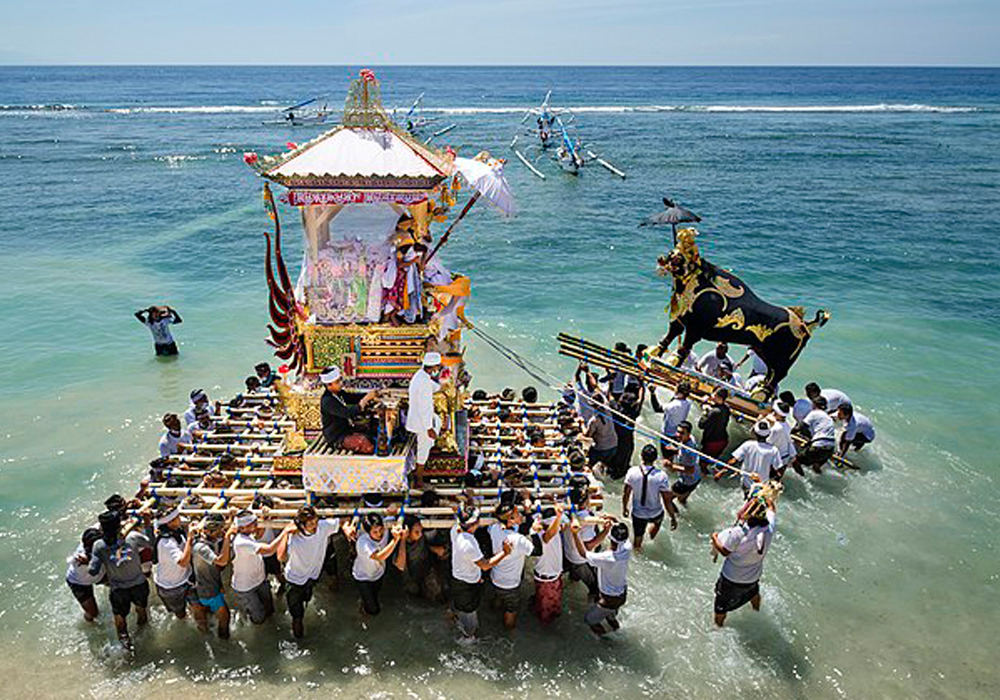
This “living art” is what makes Bali feel like a giant, open-air museum. In other places, culture is something you visit in a gallery. In Bali, culture is what blocks the traffic on a Tuesday afternoon because a cremation procession is passing through.
The Silent Day: Nyepi
Nothing illustrates Bali’s uniqueness more than Nyepi, the Day of Silence. Imagine an entire island—an international tourism hub with millions of people—shutting down completely. No lights, no fire, no work, no travel, and even the airport closes for 24 hours.
While the rest of Indonesia and the world celebrate the New Year with fireworks and noise, the Balinese turn inward. They believe that if the island is silent and dark, the evil spirits flying overhead will think the island is deserted and leave them alone for another year.
It is a profound act of collective meditation. It is the ultimate expression of local wisdom—a mandatory pause for the earth to breathe and for humans to reflect. No other place in the world has the conviction to stop the wheels of global commerce for the sake of spiritual purification.
Why It Matters for the Traveler
I find that Bali’s true magic isn’t found in the “Perfect Sunset” but in the “Perfect Devotion.”
Bali is different because it refused to let go of its roots. It took the influences of the world—the traders from India, the monks from China, the explorers from Europe—and wove them into a Balinese sarong. It is an island that proves you can be modern without losing your soul.
When you visit, don’t just look at the temples; look at the hands that built them. Don’t just eat the food; ask about the Subak that grew the rice. Listen for the Niskala in the rustle of the palm leaves.
Bali is a story that is still being written, carved into the stone and whispered in the incense smoke. It is Indonesia’s “Sacred Exception,” a reminder that in a world that is moving faster and faster, there is still a place that knows how to sit still and offer a flower to the morning sun.