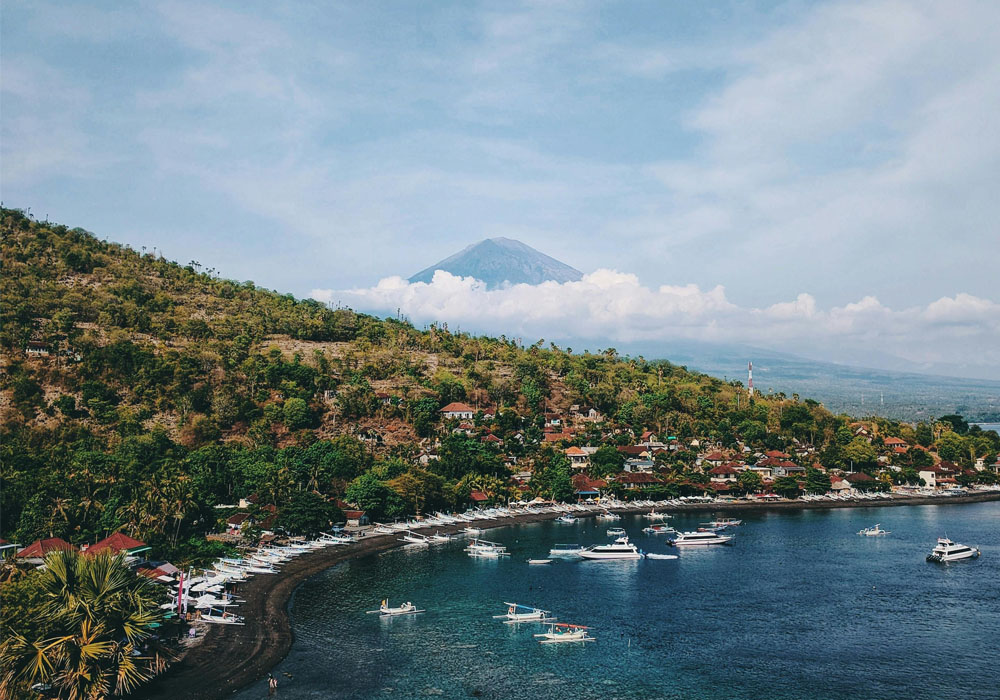
The morning air in Amed doesn’t just blow; it whispers. It carries the scent of salt crusting on volcanic sand and the faint, sweet trail of clove cigarettes from a nearby warung.
As a traveler, you quickly learn that Bali has many faces. There is the frantic pulse of Seminyak and the spiritual theater of Ubud. But Amed? Amed is the island’s deep, rhythmic breath. Stretching along the northeastern coastline under the watchful, silent gaze of Mount Agung, this string of fishing villages feels less like a destination and more like a secret kept by the sea.
The Guardian of the Horizon
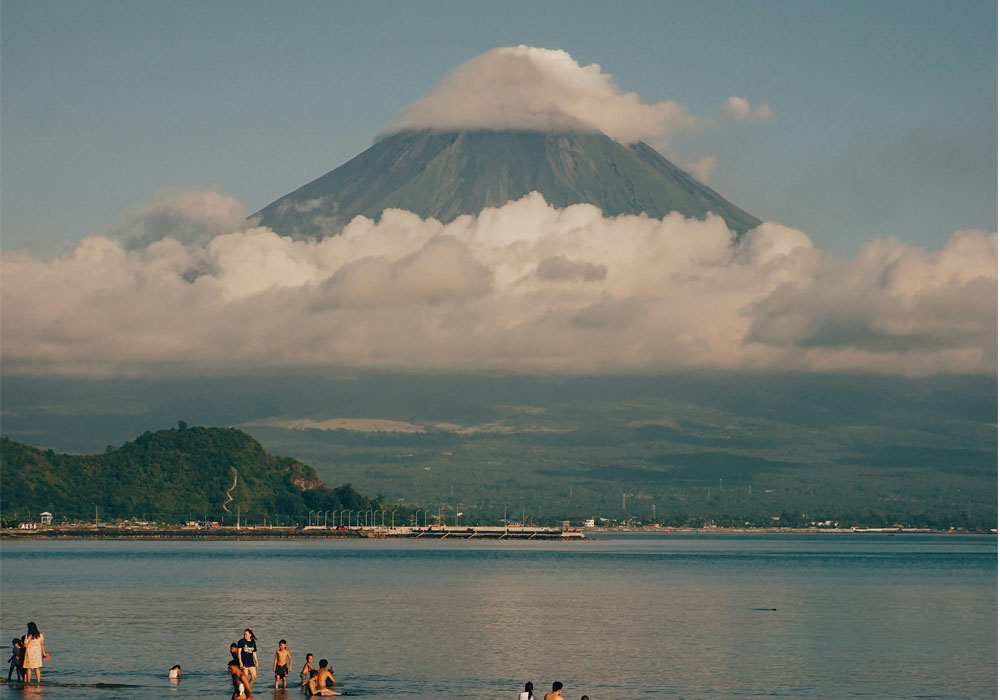
To understand Amed, you have to look up. Mount Agung, the “Great Mountain,” dominates the skyline. In Balinese Hinduism, Agung is the paku bumi—the nail of the earth. It is the center of the universe.
Walking along the black sand beaches at dawn, I watched the local fishermen push their jukung (traditional outrigger boats) into the glass-calm water. There is a specific grace to it—a quiet coordination between man and tide. They don’t fight the sea; they negotiate with it. This reflects the local wisdom of Tri Hita Karana, the three causes of well-being: harmony with God, harmony among people, and harmony with nature.
In Amed, you don’t just see this philosophy in temples; you see it in the way a neighbor helps pull a heavy boat onto the shore, or how a small offering of flowers and incense (canang sari) is placed on a boat’s prow before it sets sail.
- Looking for activities in Bali? Book a [Tour or Private Driver via GetYourGuide].
Salt of the Earth: The Alchemy of Purwakerti
One afternoon, I wandered away from the shore into the village of Purwakerti. Here, I found the traditional salt farmers, the keepers of a craft that is as much alchemy as it is labor.
Amed salt is legendary, once sought after by the Kings of Karangasem. Unlike industrial salt, this is made using aged coconut palm trunks. The farmers filter seawater through the volcanic soil, then pour the brine into these hollowed logs to evaporate under the fierce tropical sun.

I spoke with a salt farmer named Ketut. His skin was the color of polished mahogany, etched with lines from decades of sun. “The sun gives the salt its soul,” he told me, gesturing to the shimmering white crystals. “But the earth gives it the taste.”
This is the “local wisdom” that modern travel often misses. It’s the realization that patience is a physical ingredient. There is no way to rush the sun. In a world of instant gratification, Amed’s salt is a reminder that the best things—the things that nourish us—require us to wait on nature’s timing.
Life Beneath the Surface
If the land in Amed is defined by the mountain, its spirit is defined by the reef.
Jemeluk Bay is a natural amphitheater of coral. Donning a mask and fins, I slipped into the water. It’s an immediate transition from the heat of the tropics to a silent, neon-colored cathedral. Schools of blue damselfish darted through staghorn coral, and a lone hawksbill turtle drifted by, indifferent to my presence.
But there’s a deeper story here. Years ago, the reefs were struggling. The community realized that their “blue backyard” was their lifeblood. Today, local groups manage coral restoration projects. This isn’t just “eco-tourism” for the brochures; it is an act of Pawongan—the responsibility to care for the community’s shared environment so that future generations may also eat and marvel.
When you dive at the USAT Liberty wreck in nearby Tulamben, or the Japanese Shipwreck in Amed, you aren’t just looking at rusted metal. You are looking at how the ocean reclaims and repurposes. Nature takes our debris and turns it into a garden.
- Where to Sleep? We’ve filtered the best accommodation in Amed. [Check Local Rates on Agoda or Booking.com].
The Slow Tempo of the Night
As the sun dips behind Agung, the sky turns a bruised purple and orange. This is when Amed truly shines. There are no mega-clubs here, no thumping basslines to drown out the waves. Instead, there is the sound of acoustic guitars from small bars where travelers and locals sit side-by-side.
I spent my final evening at a small roadside eatery, sharing a plate of Pesan Be Pasih (fish grilled in banana leaves). The flavors were explosive—turmeric, ginger, galangal, and a heat that stayed with me.
The owner, a woman with a quick laugh, noticed me writing in my journal. “In the city, people have watches,” she said, setting down a glass of cold Bintang. “In Amed, we have time.”
That phrase stuck with me. In our daily lives, we are often obsessed with “saving” time, yet we never seem to have enough of it. In Amed, time isn’t a currency to be spent; it’s a medium to be lived in.
Why Amed Matters
Amed is a mirror. It reflects back what you bring to it. If you come looking for luxury and high-speed thrills, you might find it too quiet. But if you come with a desire to understand the rhythm of a life dictated by the mountain and the sea, it will change you.
It teaches us that:
- Balance is active: Harmony requires daily offerings and daily effort.
- Beauty is in the grit: The black volcanic sand is just as beautiful as white coral sand if you stop comparing them.
- Community is survival: No one pushes a jukung into the waves alone.
As I rode my scooter out of the valley, looking back one last time at the silhouette of Agung, I realized that Amed isn’t just a place on a map. It’s a state of mind—a quiet, salty, sun-drenched reminder that we are part of a much larger, much older story.